Should You Fix or Replace Lawn Soil?
Most struggling lawns do not need their soil hauled away. First identify whether the limiting factor is nutrient or pH imbalance, compaction, poor drainage, shallow construction fill, or something outside the soil such as shade. Improve the existing root zone when the problem can be corrected there. Consider excavation only when a physical layer, contamination concern, or necessary regrading cannot reasonably be handled in place—and get site-specific advice before doing it.
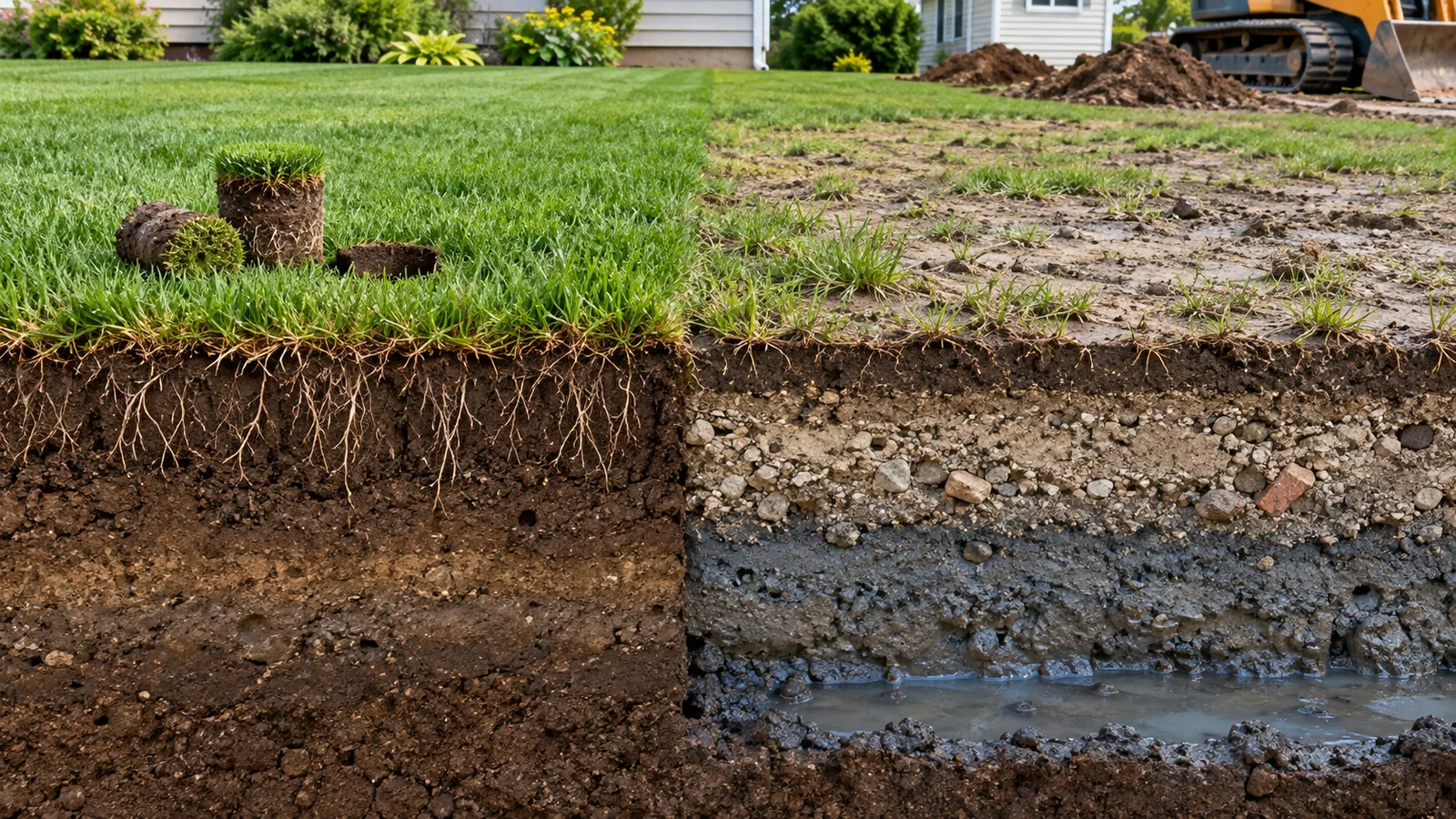
Find the bottleneck before choosing a remedy
- Map the failure. Does grass fail only along a driveway, over buried utilities, or across the whole lawn? Localized failure may indicate construction disturbance or irrigation coverage rather than uniformly “bad soil.”
- Look below the surface. Dig a small inspection hole where turf fails and one where it thrives. Compare rooting depth, abrupt layers, debris, standing water, and how easily moist soil breaks apart. Call the utility-location service before deeper digging.
- Test chemistry separately. Submit representative samples to a soil-testing laboratory for pH and nutrients, following its sampling instructions. A lab result can guide lime or fertilizer; it does not measure whether water is trapped above a compacted layer.
- Check water movement. After rain or a normal irrigation cycle, note pooling and how long the root zone stays saturated. Check that runoff from roofs or pavement is not feeding the area.
Also compare sunlight and sprinkler output. Replacing soil will not make deep shade sunny or repair a misdirected sprinkler. See why water pools on lawns if the area stays wet.
When improvement in place is reasonable
If the soil has a usable depth and drains adequately, correct measured nutrient or pH deficiencies according to the lab and local Extension guidance. If traffic compacted the lawn, reduce the traffic and consider appropriately timed core aeration where soil conditions and turf species support it. Repair the cause before reseeding. For a thin patch, use the checks in fixing patchy grass.
Do not bury existing turf beneath a thick blanket of imported topsoil or add sand by guesswork. An abrupt interface between materials can complicate rooting and water movement. Soil amendments, if needed, should match a diagnosed problem and a practical renovation plan.
When replacement or regrading may be justified
Excavation is a bigger intervention for a bigger physical constraint: extensive rubble, a very shallow soil layer over hard fill, failed grade that sends water toward a building, or a site-specific contamination finding. Removing a surface layer without addressing the underlying cause merely resets the lawn. For drainage near structures or suspected contamination, ask the relevant local professional or Extension office about testing and a site plan before moving material.
Plan for the lawn after the soil work
Choose grass adapted to the local climate and light, then establish it in the appropriate seasonal window. Keep heavy traffic off the repaired area while roots develop. If turf repeatedly fails despite corrected soil and water, reconsider whether lawn is the right cover for that spot. Topsoil versus native soil explains why the name of an imported material is not a performance guarantee.